Why being “discoverable” matters more than being talented
In architecture, design, and the wider AEC sector, opportunities don’t come only from applications.
They also come from being found.
Employers, studios, municipalities, and partners increasingly rely on search and filtering, not browsing portfolios one by one. If your profile does not appear in those searches, your skills remain invisible — no matter how good your work is.
This is where keywords become critical.
Discoverability works best when it’s part of a structured career strategy.
👉 Read the Architect’s Career Blueprint for AEC professionals
Who is searching for professionals today
Discovery happens across many contexts and by many different actors, including:
- employers and HR departments
- architectural and construction studios
- furniture manufacturers and subcontractors
- investors and municipalities
- training centers and recruiting companies
They search when:
- hiring for full-time, part-time, or freelance roles
- looking for subcontractors or project partners
- running public tenders
- seeking trainers or specialists
Your profile must work for all of these scenarios, not just job applications.
How search works in practice
Most professional platforms rely on filters and keyword-based search.
Employers typically narrow down candidates using criteria such as:
- profession or role
- specific skills
- country and city
- remote or onsite preference
- salary or hourly rate
- language
- experience level
- availability status
Instead of reviewing everyone, they search by text and skills, typing keywords that match the role they need.
If your profile doesn’t contain those terms, it simply won’t appear.
Skills are not descriptions — they are keywords
One of the most common mistakes professionals make is treating skills as vague descriptions.
In reality, skills function as searchable keywords.
Examples of skills employers actively search for include:
- software: Revit, SketchUp, V-Ray, AutoCAD, Archicad, Rhino3D, Twinmotion, 3ds Max, Excel, Bluebeam, Canva
- professional capabilities: project management, communication, leadership, creativity, coordination
If a skill is not listed explicitly, it cannot be found — even if you have it.
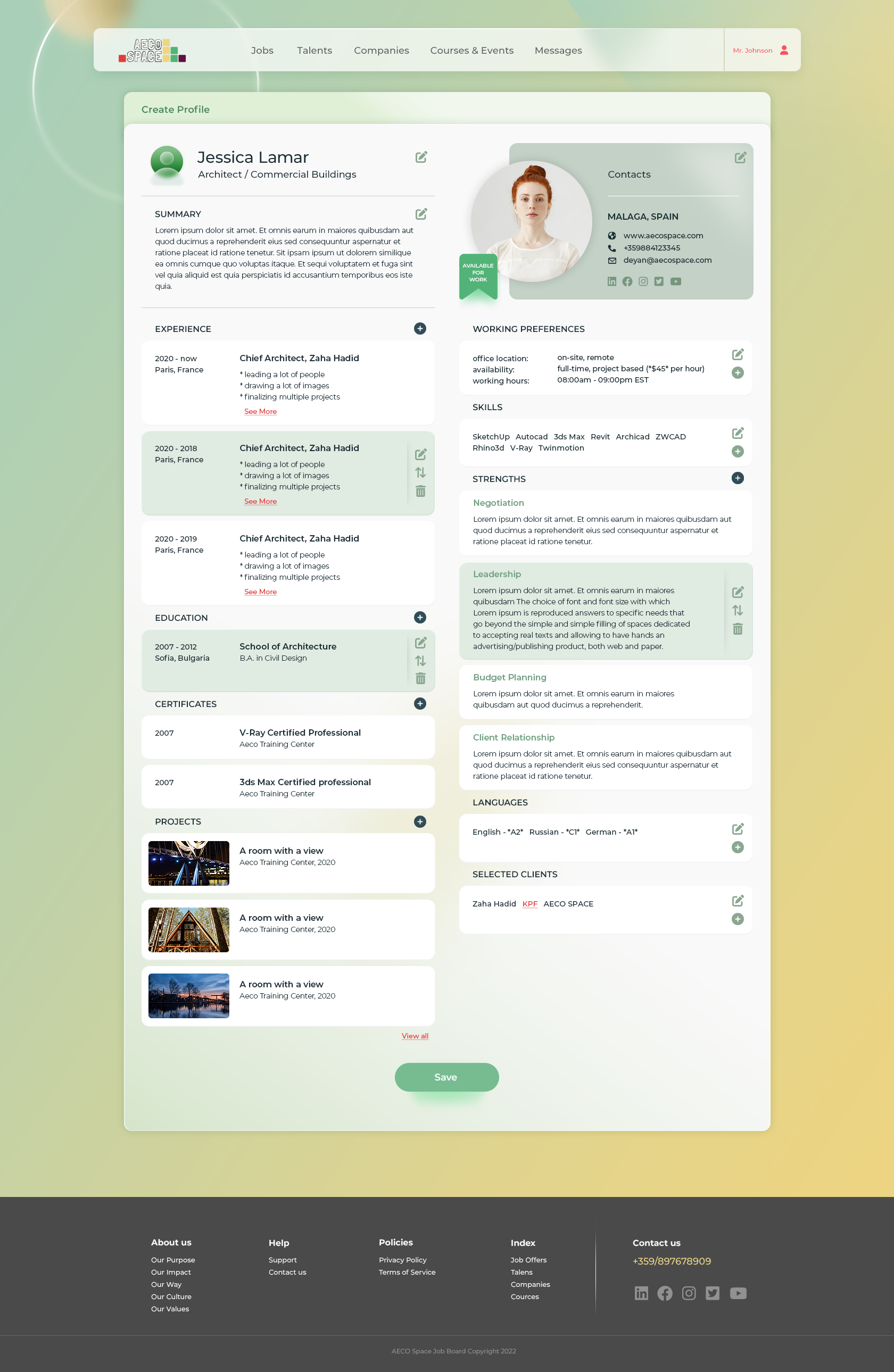
Profile fields that directly affect visibility
Search visibility depends on more than one section.
The fields that most influence whether you appear in results include:
- Title and profession – clearly describing what you do
- Summary – highlighting experience and value
- Skills – the primary keyword field
- Availability status – especially the “Available for work” indicator
- Location and work preference – country, city, remote or onsite
- Experience and education – used for filtering by seniority
- Projects or portfolio – optional, but highly differentiating
An incomplete profile dramatically reduces discoverability.
Visibility is not only about keywords, but also about how your work is presented once someone clicks your profile.
👉 Learn how employers evaluate PDF and digital portfolios today
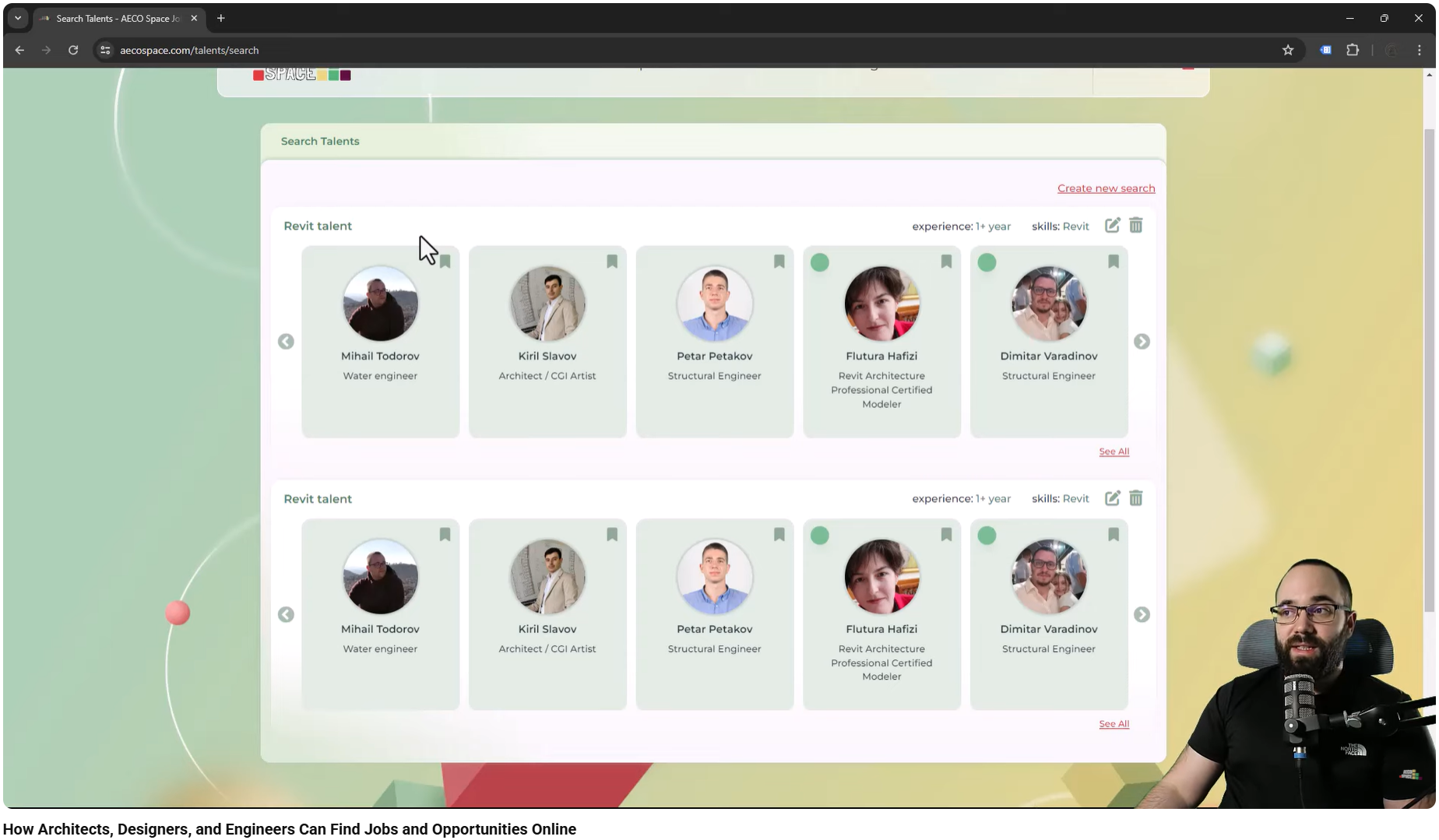
How employers and recruiters actually search
Recruiters don’t search randomly.
A typical workflow looks like this:
- filter by a key skill (for example, “Revit”)
- filter by experience level (for example, “1+ years”)
- save the search
- revisit or receive updates when new profiles match
Saved searches allow recruiters to monitor talent passively, without repeating the same steps.
If your profile matches their criteria, you appear automatically.
Common mistakes that reduce visibility
Several recurring issues consistently limit discoverability:
- Excessive humility – not stating strengths clearly makes profiles invisible
- Incomplete profiles – usernames alone are not indexed properly
- Missing availability status – recruiters filtering for “Available for work” won’t see you
- Underestimating experience – omitting valuable experience because it’s non-linear or informal
Visibility is not about exaggeration.
It is about explicit clarity.
Many of these visibility issues are not technical, but psychological. Excessive humility often prevents professionals from clearly stating their strengths.
👉 Read why humility is one of the biggest obstacles to visibility in design careers
Real examples of keyword-driven discovery
In practice, keyword-based discovery works like this:
- a hiring manager filters for “Revit” and “1+ years experience” and instantly finds matching profiles
- a designer lists “Project Management” and “Communication” as strengths, making them searchable
- interns are discovered through short-form platforms, while senior professionals are found via LinkedIn or specialized AEC platforms
The mechanism is the same: keywords determine who appears.
Practical ways to improve your discoverability
To increase your chances of being found:
- Treat skills as keywords, not descriptions
- Be specific in your profile title
- Complete all searchable fields
- Use the “Available for work” indicator when applicable
- Add projects and images to support your profile
- List all relevant experience, including challenging or unconventional paths
Your profile functions as a mini website.
If it’s incomplete, search cannot work in your favor.
Keywords create passive visibility
The most important shift to understand is this:
Once your profile is properly structured, you don’t need to actively apply everywhere.
Keywords allow employers, recruiters, and partners to find you through saved searches and filters — even when you’re not actively looking.
Visibility becomes passive.
Opportunities become inbound.